



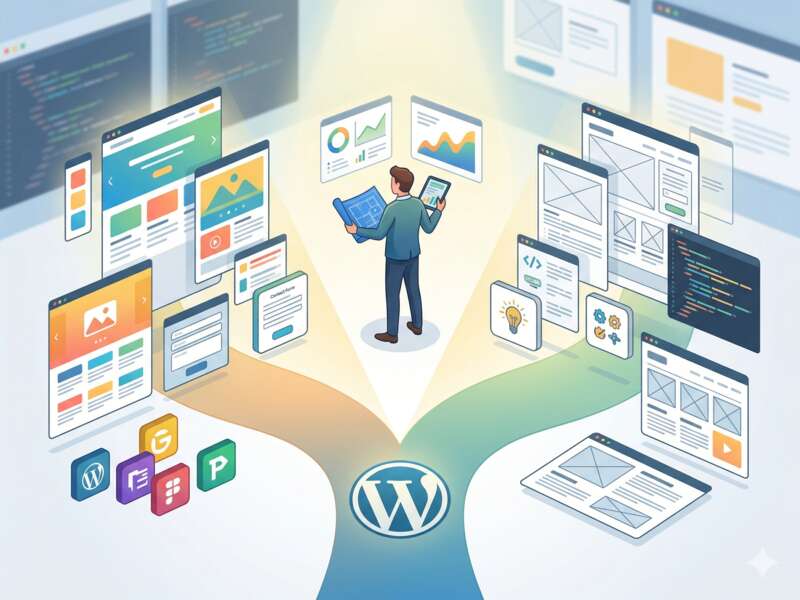
Premium Theme vs Custom Development: The Battle for the Future of Your WordPress Project
Choosing between a ready-made template (Premium Theme) and development from scratch (Custom Development) is not just a matter of budget. It is a strategic decision that will determine how flexible, fast, and secure your site will be in two years.
Many people see WordPress only as a builder where you can buy a theme on Themeforest for $59 and get a ready-made business. Others argue that the only way to success is through clean code and unique design. Let’s figure out without myths where savings end and true efficiency begins.
- Premium Theme: Deceptive Ease of Quick Start
Premium themes are the mass market in the WordPress world. They are designed to appeal to everyone at the same time. This is their main strength and their biggest weakness.
Advantages:
- Speed of launch: You can deploy demo content in an evening. For testing a hypothesis or launching a landing page “for yesterday”, this is the perfect tool.
- Price: $60 for a theme versus thousands of dollars for a custom one is an argument that is hard to ignore at the start.
- Out-of-the-box functionality: You get sliders, portfolios, Google Maps integration, and a bunch of visual effects without the need for a programmer. But you do need technical server or hosting skills to get your site up and running.
The other side of the coin (Code Bloat):
Most premium themes suffer from “obesity.” To be versatile, a theme includes code for 20 different homepage layouts, 10 header styles, and support for dozens of heavy plugins. Even if you only use 5% of these features, the remaining 95% of the code still loads, slowing down the site and messing up Google Core Web Vitals scores .
- Custom design: A suit made to your measurements
A custom WordPress site isn’t about using a “different” engine. It’s about creating your own theme (Starter Theme or Framework) where every line of code has its own purpose.
Why is this important:
- Performance: There’s nothing superfluous about a custom theme. Instead of a heavy visual builder (like Elementor or WPBakery), the developer uses native Gutenberg blocks or pure PHP/JavaScript. The result is lightning-fast loading.
- Unique UX: You don’t adapt your business to the capabilities of the template. On the contrary, the interface is created to meet the needs of your business.
- Security: Hackers often look for vulnerabilities in popular premium themes used by millions. A custom solution is “uncharted territory” for mass bot hackers.
Main disadvantage: High barrier to entry. It takes time for design, design in Figma, layout, and testing.
- Technical Comparison: A Look Under the Hood
For clarity, let’s compare these two approaches in terms of critical parameters:
| Parameter | Premium theme | Custom development |
| Speed (PageSpeed) | Often low due to unnecessary scripts | Maximum (pure code) |
| SEO optimization | Depends on the topic author (often a lot of garbage) | Full compliance with standards |
| Scalability | It is difficult to add non-standard logic | Unlimited flexibility |
| Renewal | Risk that the theme will no longer be supported | Full control over the code |
| Administration | Often cluttered settings panel | Laconic and clear interface |
- The visual builder trap
Most premium themes today are inextricably linked to page builders. This is convenient for the content manager, but it creates “vendor lock-in” . If you want to change the theme in two years, your content will be left as a bunch of unreadable shortcodes [vc_row][vc_column]….
Custom development today is increasingly based on Full Site Editing (FSE) or custom Gutenberg blocks. This allows you to keep your data clean. You can change the design of your site without having to rewrite thousands of pages of content.
- When and what to choose?
It’s not clear that one option is better than the other. It all depends on your goals.
Choose a Premium theme if:
- You have a limited budget (up to $1000).
- You need to test a niche or launch an MVP.
- The site has a typical structure (simple business card, personal blog).
- You are not planning aggressive SEO promotion in a competitive niche.
Choose Custom Development if:
- A website is a primary sales tool or service.
- You need high conversion and perfect speed performance.
- The project involves complex integrations (CRM, warehouse programs, unique calculators).
- You plan to develop a project for years and don’t want to redo it from scratch in six months.
Conclusion: Where are the real savings?
A premium theme is a savings at the start , but potential costs for support, optimization, and bug fixes in the future.
Custom development is an upfront investment that pays off in better Google rankings, higher conversions, and no technical limitations.
If you are building a serious business, remember: the client does not see the code, but he feels its quality through the speed of page response and the convenience of the interface. And in this game, a custom solution will always be one step ahead.