



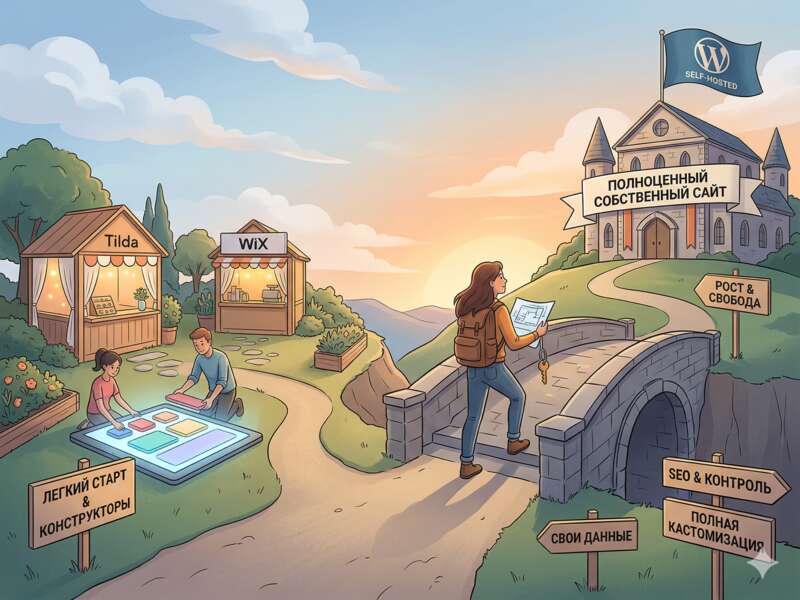
The Trap of “Fast” Websites: Why Tilda and Wix Are Becoming Too Tight for Your Business
When you’re just starting a project, the idea of “building a website on your own” over the weekend seems like a lifeline. Builders like Tilda or Wix are appealing with their deceptive simplicity: drag a block, replace an image, and voila, you’re on the air. But a year passes, your business grows, and suddenly you hit a low ceiling that you can’t break through.
Let’s be honest: a designer is like renting an apartment with someone else’s furniture, where you’re not even allowed to change the wallpaper without the owner’s permission. A self-hosted solution (like WordPress on your own hosting) is your own home. And that’s why at some point moving becomes not just desirable, but critically necessary for survival.
The illusion of cheapness and hidden taxes of designers
The first mistake many entrepreneurs make is to think that a designer saves money. Yes, at the start you don’t pay the developer. But you start paying a “growth tax.”
- Monthly bondage. You don’t own the site. As soon as you stop paying the subscription fee, your business disappears from the network. Over 3-4 years, the cost of renting a designer often exceeds the cost of professional WordPress development, which would be 100% yours.
- Functionality limitations. Do you want to connect a specific payment system, set up a complex cost calculation form, or integrate the site with a local CRM? The designer will answer: “This is not possible” or “Buy our most expensive Enterprise plan.”
- The golden cage ecosystem. You can’t just take your site from Wix and move it to another host because it’s slow. You’re hostage to their infrastructure.
SEO ceiling: why Google “dislikes” rented pages
SEO is a game of millimeters. To be first, the site must be perfect from a technical point of view. Designers sin with “dirty” code. When you assemble a page from ready-made blocks, the system generates tons of unnecessary garbage in the code, which slows down the loading.
For Google, speed (Core Web Vitals) is the law. On a self-hosted site, we can optimize every little thing: compress images to WebP format, configure caching at the server level, remove unnecessary scripts. With Tilda or Wix, your maximum is what the platform developer has allowed. You cannot influence the server settings, and therefore you will always be one step behind competitors who have invested in professional code.
Data ownership and security issues
Imagine the situation: a service decides to leave the market (as often happens with international platforms in turbulent times) or blocks your account due to an algorithm error. Along with it, your content, your orders, and the results of years of promotion disappear.
On WordPress (self-hosted), you are the full host.
- Your database resides on your chosen hosting.
- You decide when to make backups.
- You can physically copy the site files to a flash drive and move them anywhere you want.
This is the fundamental difference between a “rental” and an “asset.” A business that plans to operate for 5-10 years cannot afford to be dependent on the mood of a third-party platform’s management.
When does the “alarm bell” ring?
How do you know it’s time to move to a full-fledged website? Here are some symptoms:
- A marketer says they can’t install a pixel or configure a specific event. Designers often restrict access to
<body>or<head>. - The site became “heavy.” The number of pages increased, and the designer began to “slow down” in the admin area and on the front end.
- You need uniqueness. You see dozens of sites online that are similar to yours because they all use the same standard blocks (Tilda’s Zero Block only partially saves, but requires a lot of manual work).
- You want automation. You’re tired of manually copying orders into Excel because full two-way integration with your warehouse is impossible in the designer.
The future of your project: scalability without limits
The main advantage of switching to professional self-hosting is the absence of the word “no”. Do you need a personal account for customers with order history? Yes. Do you need multilingualism in 10 languages with different domains? No problem. Do you need to implement artificial intelligence to generate product descriptions? This is done using the API.
A construction set is a child’s bike. It’s great for learning to ride. But if you’re going to hit the highway of big business, you need a car where you control the engine yourself.
Moving to a standalone platform isn’t just about “changing the engine.” It’s an investment that frees up your hands and paves the way for true SEO and technical independence. Don’t wait until the builder becomes so cramped that it starts to stifle your sales. Move to your own digital office in time.