



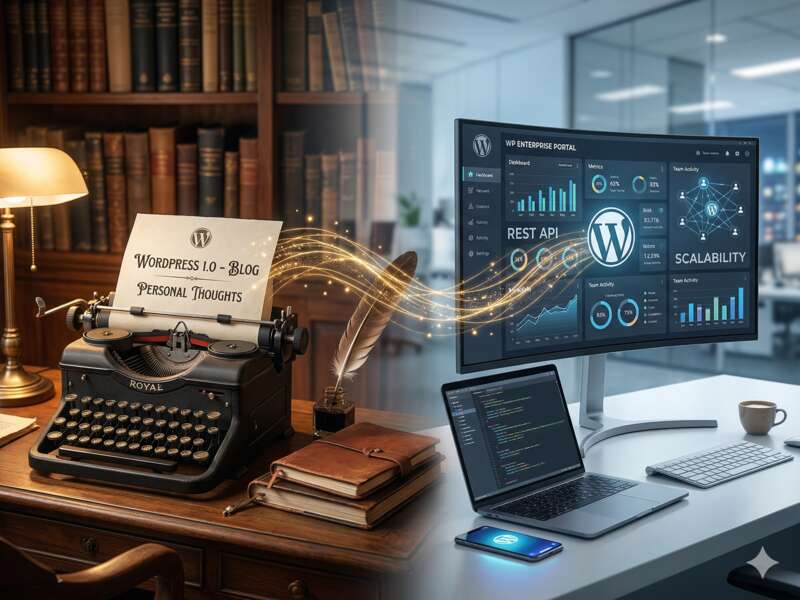
The WordPress Ecosystem: How a Former Blogging Engine Became the Foundation of Enterprise Solutions
There’s a persistent stereotype stuck in the 2010s that WordPress is all about personal diaries, simple business card sites, and endless plugins that slow down the system. But while skeptics held onto these beliefs, WP’s architecture has gone through a journey comparable to the evolution from a simple text editor to a full-fledged operating system for the web.
Today, not only local coffee shops operate on this platform, but also resources such as The New York Times, the official White House website, and complex Fortune 500 ecosystems. Why are large businesses, with budgets for development “from scratch”, increasingly choosing this Open Source foundation?
The genetic code of flexibility: from records to objects
At the dawn of its existence, WordPress operated with two concepts: “post” and “page.” It was a rigid structure. The revolution happened when developers got the Custom Post Types tool.
This has turned the system into plasticine. Now a “post” is not just text with a picture. It can be:
- A real estate object with dozens of characteristics (area, district, price).
- Doctor’s profile on the medical portal with appointment schedule and reviews.
- A complex educational course with a nested structure of lessons and tests.
It was the ability to create your own content types and the relationships between them that brought the platform out of the blog sandbox and into the league of corporate portals. Businesses got the opportunity to build complex databases without reinventing the wheel with an admin panel that is already intuitive for managers.
API-first: WordPress as a “head” without a body
The biggest technological leap in recent years has been the introduction of the REST API. This has transformed WordPress into a Headless CMS.
What does this mean for large businesses? Previously, you were limited to the platform’s own templates. Now, WordPress can serve as a powerful backend (data storage and control panel), while the external part of the site (frontend) can be written in React, Vue.js, or Next.js.
Corporations choose this path because:
- Security: The frontend is completely separated from the database, which minimizes the risks of SQL injections.
- Speed: Using modern JS frameworks allows pages to fly, providing the instant response that Google values so much.
- Omnichannel: A single WordPress admin panel can send content simultaneously to a website, mobile app, self-service terminals, and smartwatches.
Scalability: The Myth of the “Heavy” Engine
One of the most common comments is: “WordPress won’t handle high loads.” This is a technical error. It’s not the CMS that handles the load, but the server architecture.
For large corporate portals, today a stack is used that was previously available only to a narrow circle of system administrators:
- Object Caching (Redis/Memcached): Allows you to not pull the database every time, but to output ready-made results from memory.
- Elasticsearch: Provides instant search across millions of records, which is critical for large media resources or marketplaces.
- WP-CLI: The ability to manage your site via the terminal, automate updates and deployments, which is standard in professional development.
When we talk about the corporate sector, WordPress is no longer about installing 50 plugins. It’s about clean code, object-oriented programming in PHP, and using the platform as a framework on which to build a unique architecture.
Security in the Enterprise segment: paranoia as the standard
For a corporation, a data leak or a “white screen” is a loss of millions. Open Source is often accused of vulnerability, but the truth is that the openness of the code makes it the most tested in the world. Thousands of developers are looking for holes every day, which are closed faster than in any closed commercial system.
A modern corporate website on WP is protected at several levels:
- Application Firewall (WAF): Blocks bots before they even touch the site code.
- Environment Isolation: Separation of development (Staging) and production version (Production) via Git.
- Two-factor authentication and custom roles: In a large company, a marketer shouldn’t have access to server settings, and a copywriter shouldn’t have access to financial reporting. The role system in WP allows you to customize this down to the smallest detail.
The Economics of Ownership: Why a Custom Engine is a Trap
Many companies at the start order “self-written” systems, considering them unique. The problem arises after 2 years, when the developer disappears. You become a hostage to the code that no one can read.
WordPress offers a standard. If your agency or programmer decides to change their field of activity, you will find thousands of other specialists who know how the core of the system works. This ensures business continuity. You invest money in unique functionality and design, not in developing a bicycle for user authorization or image upload.
The future: AI and automation
Evolution doesn’t stop. WordPress now integrates artificial intelligence at the core (Gutenberg and AI assistants). For corporations, this means automatic metadata generation, content translation into 20 languages in seconds, and personalized delivery for each client.
Thanks to Gutenberg (a block editor), creating complex landing pages within a large portal has become a task for the content manager, not the development department. This saves hundreds of hours of work every month.
Strategic choice
The transition from a “blogging engine” to the foundation of enterprise systems has been seamless for those who don’t follow the code. Today, choosing WordPress for a large project is not a compromise, but a pragmatic decision. It’s a choice in favor of speed to market, flexible integrations, and a huge community that ensures your technology won’t be obsolete tomorrow.